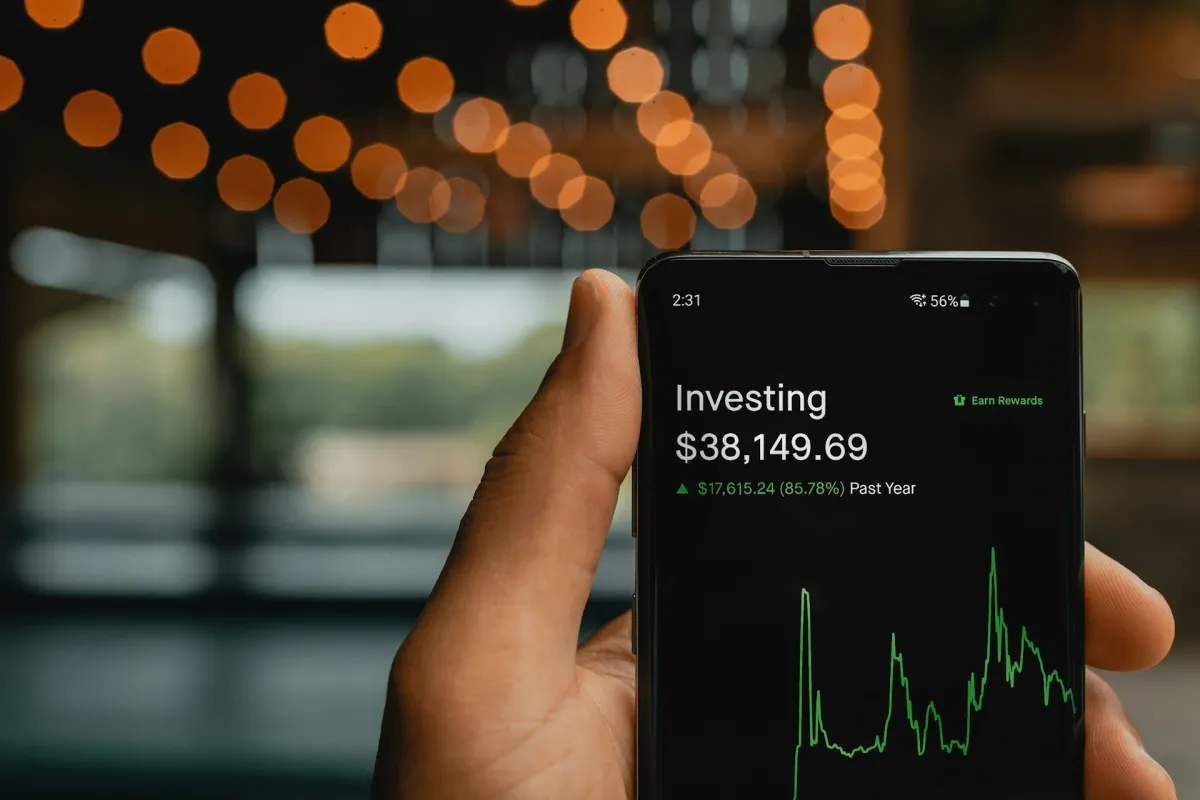
What if I invested $5 a day, every day, and just left it alone? At a realistic 7 percent average return, that small habit turns into about $26,000 in ten years, roughly $79,000 in twenty, and over $185,000 in thirty. That's the short version, and it's the reason this question keeps getting asked. But the headline number hides a few things worth understanding before you get excited, including where that money ends up, why the first decade feels disappointing, and what inflation does to those totals. Let me show you the real math, and the real catches.
So, What If I Invested $5 a Day? The Numbers, No Hype
Let's get straight to the part you came for. If you invest $5 a day and earn an average annual return of about 7 percent (a reasonable long-term assumption for a diversified stock fund after inflation), here's roughly how it plays out. After 10 years you've contributed $18,250 and you'd have around $26,300. After 20 years you've contributed $36,500 and you'd have about $79,200. After 30 years your $54,750 in contributions could be worth roughly $185,500. And after 40 years, your $73,000 turns into close to $400,000.
Notice what's happening there. In year ten, growth added about $8,000 on top of what you put in. By year forty, growth added more than $326,000. The amount you contribute barely changes from one decade to the next, but the gap between what you put in and what you end up with explodes. That widening gap is compound interest doing its slow, patient work, and it's the entire reason starting small and starting early beats starting big and starting late.
If you'd rather aim higher, the stock market's long-run history is more generous than 7 percent. Using the S&P 500's historical average instead, the 30-year figure climbs past $340,000 and the 40-year figure gets close to a million dollars. I want to be careful with that bigger number, though, because it assumes the next few decades resemble the last several, and nobody can promise that. I'll stick with the conservative 7 percent for the rest of this post so we don't oversell the dream.
Where the $5 a Day Figure Comes From
Five dollars a day is a clean, friendly number, but it's worth seeing what it really means on a yearly basis. Five dollars times 365 days is $1,825 a year. That reframing matters, because $5 sounds like nothing while $1,825 sounds like a real financial commitment, and they're the exact same thing. The daily framing is mostly a psychological trick to make the habit feel painless, which is fine, as long as you know the annual number you're signing up for.
In practice, almost nobody literally transfers $5 every single day. You'd drown in tiny transactions and probably trip over account minimums or fees. What most people do is automate roughly $152 a month, or about $38 a week, into an investment account. The math works out the same, and automation is the real engine here. When the money moves on its own, you never have to summon the willpower to invest, which is where most good intentions quietly die.
Why the First Ten Years Feel Like Nothing Is Happening
Here's the part most $5-a-day articles skip, and in my experience it's the reason people quit. For the first decade, this strategy feels underwhelming. You've handed over $18,250 of your own money, and you're sitting on maybe $26,000. The growth is real, but it's modest, and your brain does the math and thinks, "I worked this hard for an extra eight grand?" That's the dangerous moment. It's also exactly when you should keep going.
Compound growth is back-loaded. The dramatic returns don't show up at the start because there isn't much money in the account yet to compound on. The curve only bends sharply upward once your balance gets big enough that the annual growth dwarfs your annual contributions. In the $5-a-day example at 7 percent, the growth in a single year somewhere around year 25 quietly surpasses the entire $1,825 you contribute that year. After that point, your money is earning more than you're adding. That's the tipping point everyone is chasing, and it only arrives if you don't bail during the boring middle.
The hard part of investing $5 a day isn't the $5. It's staying in your seat through the decade where it feels like nothing is happening.
Want a number that drives this home? If you start the $5-a-day habit ten years earlier, those ten extra years are worth far more than the money you put in during them. At 7 percent, investing for 40 years instead of 30 lands you around $399,000 instead of $185,000. That one extra decade added more than $213,000 to your final total, even though you only contributed about $18,000 more during it. The early years are quiet, but they're carrying the entire back end of the curve.
Where to Put Your $5 So It Grows
A daily habit only works if the money lands somewhere sensible. For most people building long-term wealth, that means low-cost, broadly diversified index funds rather than individual stocks. A total-market index fund or an S&P 500 index fund spreads your $5 across hundreds or thousands of companies, so you're not betting everything on any single one. The returns I've been quoting assume something like this, not a hot stock pick or a meme coin. I'm not a financial advisor and this isn't tailored advice, but the boring, diversified option is exactly what those compound-growth numbers are built on.
The account you use matters just as much as the fund, mostly because of taxes. A few common options in the United States: a Roth IRA lets your money grow and come out tax-free in retirement, which is powerful for someone with decades ahead of them. A traditional 401(k), especially with an employer match, is hard to beat because the match is effectively free money on top of your $5. A regular taxable brokerage account has no special tax perks but also no withdrawal restrictions, so it's flexible. The right pick depends on your situation, and this is the kind of decision where a quick chat with a fee-only financial planner can pay for itself.
If you're outside the US, the names change but the idea doesn't. Most countries have some version of a tax-advantaged investment account, like an ISA in the UK or a TFSA in Canada, and low-cost index funds are widely available through them. The principle is universal: keep your costs low, stay diversified, and let time carry the weight. If you want to run your own version of these projections with your real numbers, a free compound interest calculator takes about two minutes and makes all of this feel a lot more concrete.
The Catch the Headlines Skip: Inflation, Fees, and Taxes
Now for the honest part, because those big final numbers come with fine print. The first and biggest catch is inflation. That projected $185,500 after 30 years is in future dollars, not today's. If inflation averages around 3 percent, $185,500 thirty years from now has the buying power of roughly $76,000 today. It's still a wonderful return on $5 a day, but it's not the same as having $185,500 in your pocket right now, and any article that flashes the big number without mentioning this is selling you something.
The second catch is fees. A fund charging 1 percent a year instead of 0.05 percent might not sound like much, but over 40 years that difference can quietly eat a six-figure chunk of your ending balance. This is the single easiest mistake to avoid: check the expense ratio of anything you buy and favor the cheap index funds. The third catch is taxes, which is why the account type from the last section matters so much. In a regular taxable account, you may owe tax on dividends along the way and on gains when you sell.
There's one more caveat worth saying out loud: the market doesn't go up in a straight line. Some years it drops 20 or 30 percent, and these projections assume you don't panic-sell when that happens. The people who capture those long-term averages are the ones who keep their automatic $5 flowing through the scary years, buying more shares while prices are low. Behavior, not math, is usually what separates the people who hit these numbers from the people who don't.
Is It Really About the Coffee? The Latte Factor, Reconsidered
You've probably heard the framing that skipping your daily coffee and investing the money instead will make you rich. There's truth in it, but it's also been fairly criticized, and I think both sides have a point. The critics are right that you can't cut your way to wealth on $5 a day alone if your income barely covers rent. Small savings matter most once the basics are already handled, and pretending a latte is the difference between poverty and retirement ignores bigger forces like wages and housing costs.
But here's the defense, and it's the part I find more interesting. The coffee was never really the point. The point is building a system where a small amount of money moves automatically into something that grows. The $5 could come from a coffee, a couple of streaming services you don't watch, or simply rounding up your spare change. What matters is the mechanism, not the sacrifice. Once that automatic pipe is built, you can widen it whenever your income grows, and the habit is already in place.
The $5 was never about giving up coffee. It's about building a system small enough that you'll keep it running for thirty years.
This is also why I'd rather see someone start with $5 they'll never miss than wait until they can "afford" to invest seriously. Waiting for the perfect amount usually means waiting forever. A tiny, consistent habit you keep beats an ambitious plan you abandon in three months, every single time. Start where you are, and let the amount grow with you.
How to Start This Week Without Overthinking It
Enough theory. If this post convinced you, here's how to turn it into something real. First, open a low-cost brokerage account or retirement account if you don't have one. Most major brokerages let you do this online in under fifteen minutes with no minimum to start. Second, pick one broad, low-cost index fund, where a total-market or S&P 500 fund is a fine default. Third, set up an automatic transfer of about $152 a month, timed for right after you get paid.
That's the whole thing. The temptation is to research for months, compare a dozen funds, and wait for the market to "feel safe." Skip all of that. The single biggest factor in your result isn't picking the perfect fund or timing the perfect entry, it's the number of years your money stays invested. A decent plan started today beats a perfect plan started next year, because you can't get those compounding years back later.
One more practical note: make sure you've got a small emergency fund and no high-interest debt before you go all-in on investing. Paying off a credit card charging 22 percent is a guaranteed 22 percent return, which beats any stock market projection. Once that's handled, the $5-a-day habit can run quietly in the background for decades.
The Bottom Line on $5 a Day
So, what happens if you invest $5 a day? Handled patiently in a low-cost, diversified fund at a realistic return, it grows into tens of thousands of dollars within a couple of decades and well into the six figures over a working lifetime. The catch is that it asks for the one thing that's hardest to give: time, and the discipline to leave it alone through the quiet years and the scary ones. The math is the easy part. Staying in your seat is the real work.
If you take one thing from this, let it be this: the best day to start was years ago, and the second best day is today. Open the account, automate the transfer, then mostly forget about it. Your future self will be grateful you started when the number felt too small to matter, because that's exactly when it mattered most.
Your clear next step: this week, open an investment account and schedule one automatic transfer, even if it's just $5. Then, if you want to see what your own number could become at different return rates and time horizons, run it through a free compound interest calculator with your real figures. Seeing your personal projection on the screen is usually the thing that turns "someday" into "I started today."